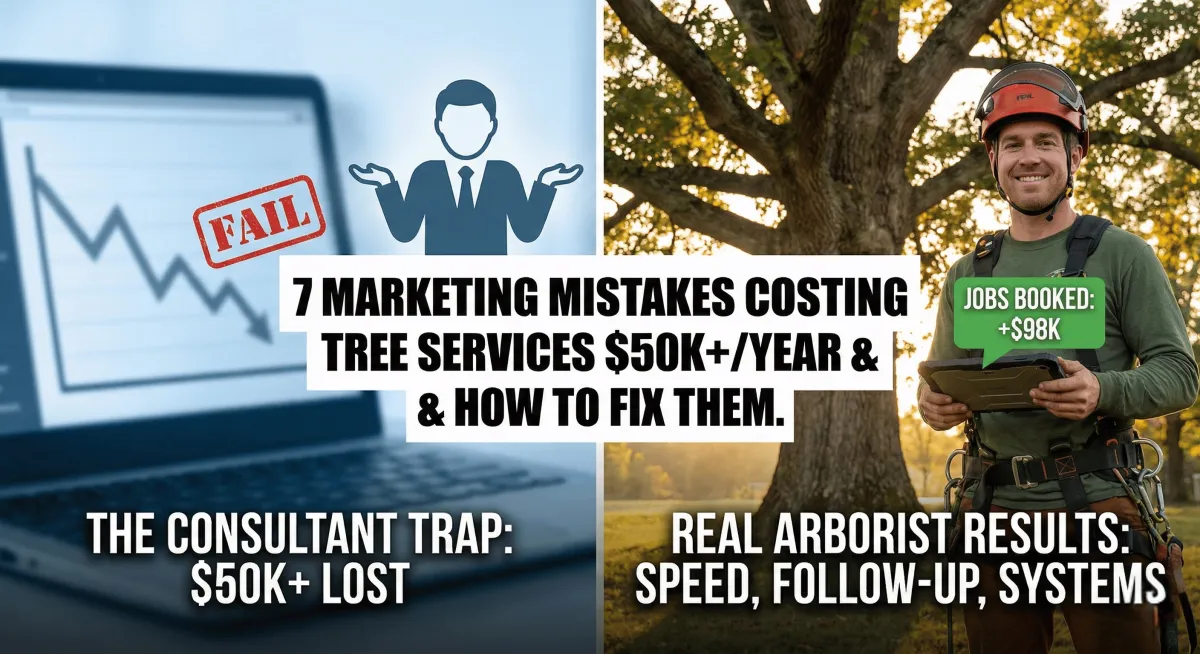
I Ran a 7-Figure Tree Service for 6 Years. Here's What Most Marketing Agencies Get Wrong.
📋 TL;DR
Most marketing agencies fail tree services because they treat you like a tech startup, not a service business. After running a 7-figure tree service for 6 years and helping 200+ companies scale, I've identified 7 critical mistakes agencies make that cost you $50K+/year in lost revenue. This post reveals what actually moves the needle: speed-to-lead (not SEO rankings), follow-up systems (not fancy websites), and operational integration (not more traffic).
📑 Table of Contents
Mistake #1: Obsessing Over Rankings Instead of Response Time
Mistake #5: Running Ads Without Understanding Unit Economics
Introduction: The $87,000 Wake-Up Call
Three years into running my tree service, I made a decision that cost me $87,000.
I hired a "digital marketing agency."
They had a slick presentation. They threw around terms like "omnichannel strategy" and "brand positioning." They showed me case studies from... wait for it... a yoga studio and a software company.
Should've been my first red flag.
Six months and $18,000 later, here's what I got:
A "redesigned" website that looked pretty but converted worse
An SEO strategy that ranked me #1 for "tree removal tips" (great, except nobody searching that is ready to buy)
A social media calendar posting tree facts (my Facebook engagement went up 40%... my revenue stayed flat)
Monthly reports full of vanity metrics that didn't translate to booked jobs
Meanwhile, I was still working 70-hour weeks. Still losing quotes to competitors. Still dealing with the same operational chaos.
The breaking point? I calculated what those lost leads actually cost me. Conservative estimate: $87,000 in revenue I could've captured if I'd focused on what actually mattered.
That's when I fired them and built my own system—the same system that took my tree service to 7 figures and now powers Arbor Advantage for 200+ service-based businesses.
Let me save you the $87,000 lesson and show you exactly what most agencies get wrong about marketing for tree services.
The Consultant Problem: They've Never Run Your Business
Here's the fundamental issue with 95% of marketing agencies:
They've never operated a tree service. They've never run crews. They've never dealt with storm work at 2 AM. They've never had to explain to a homeowner why that $8,000 removal is actually worth it.
They learned marketing from a course or a corporate job. Then they read a blog post about "local SEO for service businesses" and decided to hang a shingle.
And look—I'm not saying education doesn't matter. But there's a massive difference between:
Knowing marketing theory → "Let's optimize your Google Business Profile with strategic keywords and build citations across 50 directories."
vs.
Understanding tree service operations → "Your GBP is fine. The real problem is you're taking 3 days to follow up on storm work leads when your competitors are responding in 30 minutes. That's why you lost that $35K contract last week."
One sounds impressive. The other makes you money.
When I consult with tree service owners now, I can spot the bottlenecks in the first 10 minutes because I've been there. I know where the money leaks. I know what converts a $2,500 quote into a $4,200 sale. I know which marketing activities are theater and which ones directly impact your bank account.
That operational credibility? That's the difference between an agency that costs you money and a partner that makes you money.
Mistake #1: Obsessing Over Rankings Instead of Response Time
What agencies say: "We got you to #1 for 'tree removal [your city]'!"
What actually matters: How fast you respond when that lead calls.
Here's what most agencies won't tell you: Response time beats ranking every single time.
MIT did a study on this. Companies that respond to leads within 5 minutes are 21x more likely to qualify that lead than companies that wait 30 minutes.
In tree services? That gap is even bigger.
When a homeowner sees a tree leaning toward their house after a storm, they're not comparison shopping. They're calling the first 3-5 companies they find and hiring whoever responds first with confidence.
I've seen tree services ranked #3 or #4 in Google absolutely dominate competitors ranked #1—because they had a system to respond in 90 seconds.
Real example from my operation:
My tree service was never #1 organically for our primary keywords. We hovered around #3-4. But our close rate on organic leads was 47%.
Our competitor who ranked #1? Their close rate was 31%.
The difference? We had an automated SMS response that fired within 60 seconds of a web form submission. They had a contact form that went to an inbox checked twice a day.
By the time they responded, we'd already booked the estimate.
What agencies should focus on instead:
Instant lead notification systems
Automated SMS/email response within 60 seconds
Click-to-call tracking that routes to available estimators
Calendar booking links in every communication
Response time monitoring and alerts
Rankings matter. But speed-to-lead matters more. And most agencies have no idea how to build that infrastructure because they've never had to.
Mistake #2: Building Pretty Websites That Don't Book Jobs
What agencies say: "Your website needs a complete redesign with modern UX/UI."
What actually matters: Can someone book an estimate in under 60 seconds on mobile?
I cannot tell you how many tree service websites I've audited that look absolutely gorgeous... and convert like garbage.
Agencies love redesigns because:
They can charge $8,000-$15,000
It looks like "real work" in their monthly reports
It satisfies the owner's ego ("Look how professional we look now!")
But here's what they don't optimize for:
Mobile booking flow - 73% of tree service searches happen on mobile. Can someone request a quote in 3 taps or less?
Above-the-fold CTA - Is your phone number and booking button visible without scrolling?
Trust signals - Reviews, certifications, insurance proof, years in business—all above the fold
Service area clarity - Do people immediately know if you serve their location?
Emergency vs. routine split - Storm damage needs a different path than spring pruning
Load speed on 4G - Your fancy parallax scrolling is costing you conversions on slower connections
Real numbers from my tree service:
Version 1 (the "pretty" one my first agency built):
Load time: 4.8 seconds
Mobile conversion rate: 2.1%
Bounce rate: 67%
Version 2 (the "ugly" one I built focused purely on conversion):
Load time: 1.2 seconds
Mobile conversion rate: 8.7%
Bounce rate: 43%
That 6.6% lift in mobile conversion rate? That translated to an extra 11 booked estimates per month. At a $2,800 average ticket and 38% close rate... that's $11,628 in additional monthly revenue.
From making the site "uglier."
The lesson: Your website is not a billboard. It's a conversion machine. Agencies that focus on aesthetics over function are costing you real money.
Mistake #3: Treating All Leads Like They're Equal
What agencies say: "We increased your lead volume by 40%!"
What actually matters: How many of those leads can afford your premium pricing?
Not all leads are created equal. But most agencies optimize for volume, not quality.
Here's a scenario I see constantly:
The agency runs Facebook ads. They're targeting "homeowners interested in home improvement" within 25 miles of your location. The ads are getting cheap clicks ($0.47 per click!). Lead volume is up!
Except...
30% of the leads are renters who can't authorize work
25% are price shoppers looking for the cheapest option (you're never going to win these)
20% are "just browsing" with no immediate need
15% are outside your service area but close enough to click
So out of 100 leads, maybe 10 are actually qualified. And you're paying the agency based on the total lead count.
What I did differently:
I segmented leads into tiers:
Tier 1 - Hot Leads (respond within 5 minutes):
Storm damage (emergency)
Tree on house/structure
Google LSA leads (high intent)
Referrals from past customers
Tier 2 - Warm Leads (respond within 5 minutes):
Routine removals
Pruning/trimming
Organic search leads
Calendar booking requests
Tier 3 - Cold Leads (automated nurture):
"Just looking" / no urgency
Price shoppers
Out-of-season inquiries
Informational questions
This tiering system meant my estimators weren't wasting time chasing garbage leads while hot opportunities went cold.
The result? Our close rate on Tier 1 leads was 64%. On Tier 2, it was 41%. On Tier 3, it was 12%.
If you're treating all leads the same, you're either over-servicing low-value leads or under-servicing high-value ones. Both cost you money.
Most agencies don't segment because they're not thinking about your close rate or profitability. They're thinking about their monthly retainer and whether they can show "lead growth" in their reports.
Mistake #4: Ignoring Your Biggest Revenue Leak: Follow-Up
What agencies say: "We'll get you more traffic!"
What actually matters: What happens to leads you already have but didn't close?
Here's a stat that should terrify you: The average tree service follows up with a lead 1.3 times before giving up.
Meanwhile, research shows it takes 5-12 touchpoints to convert a lead in the service industry.
That means you're leaving 60-70% of your potential revenue on the table just from poor follow-up.
But agencies don't care about this because it's "not marketing." It's operations. It's sales. It's not their job.
Except it absolutely should be.
When I calculated my follow-up leak, here's what I found:
In one year, my tree service generated 847 leads. We booked estimates with 412 of them (48.6% conversion rate—pretty good!).
Of those 412 estimates:
156 hired us immediately (38% close rate)
97 hired someone else (23%)
159 said "let me think about it" and we never followed up (39%)
That 159? Those weren't lost leads. They were abandoned revenue.
Conservative math: If I'd followed up properly and closed even 25% of them (way below our normal close rate), that's 40 additional jobs.
At $2,800 average ticket = $112,000 in revenue I left on the table.
So I built a follow-up system:
Day 2: SMS check-in
Day 4: Email with case study from similar job
Day 7: Personal video explaining the quote
Day 10: Phone call
Day 14: "Last chance" email with limited-time discount
Day 30: Move to quarterly nurture sequence
First year with this system? We recovered $43,000 in jobs that would've been lost. Second year? $67,000.
And here's the kicker: the entire system runs on autopilot in Arbor Advantage CRM. It costs nothing in labor. It just prints money.
But your agency will never build this for you because they don't understand the gap between estimate and close. They've never sat in a truck explaining a quote. They've never felt the pain of "I'll think about it."
Mistake #5: Running Ads Without Understanding Unit Economics
What agencies say: "Your cost per lead is down to $42!"
What actually matters: What's your cost per booked job? Per dollar of revenue?
Most agencies optimize for cost per lead (CPL) because it's easy to measure and sounds impressive in reports.
But CPL is a vanity metric if you don't know your full funnel economics.
Here's what you actually need to know:
The Full Funnel:
Cost per lead (CPL): $42
Lead-to-estimate conversion rate: 52%
Estimate-to-close rate: 38%
Average ticket: $2,800
The real math:
100 leads = $4,200 ad spend
52 booked estimates (52% conversion)
19.76 closed jobs (38% of estimates)
Revenue: $55,328
Cost per acquisition: $212.55
Return on ad spend: 13.2x
Now let's say an agency comes in and "optimizes" your CPL down to $28 by targeting broader, cheaper audiences.
New math with worse quality leads:
100 leads = $2,800 ad spend
31 booked estimates (31% conversion - lower quality)
9.61 closed jobs (31% close rate - price shoppers)
Revenue: $26,908
Cost per acquisition: $291.33
Return on ad spend: 9.6x
Lower CPL. Worse results. Half the revenue.
This is why I obsess over the entire funnel, not just the top. And this is why most agencies fail tree services—they optimize the wrong metrics.
What you should demand from any agency:
Full funnel tracking (lead → estimate → close)
Cost per booked job, not just CPL
Revenue attribution by channel
Average ticket by lead source
Close rate by lead source
Lifetime value analysis
If they can't provide this, they're flying blind. And so are you.
Mistake #6: No Integration With Your Operations
What agencies say: "We'll handle all your marketing!"
What actually matters: Can your crews execute on what marketing promises?
Marketing doesn't exist in a vacuum. It's connected to operations, scheduling, crew capacity, and customer experience.
But agencies treat marketing like a separate department because they don't understand how tree services actually run.
Here's a real example of this disconnect:
Agency runs aggressive storm work campaign. They're crushing it—50 leads in 72 hours.
Problem? You only have 3 crews. Your schedule is already booked for the next 5 days. You can't service even half these leads in time.
So what happens?
Leads go cold waiting for estimates
Customers get frustrated
Negative reviews start appearing ("they never showed up for the estimate")
Your reputation takes a hit
Future conversion rates drop
The agency? They're celebrating the lead volume in their monthly report.
What integration actually looks like:
At my tree service, marketing was tied directly to operational capacity:
CRM showed crew availability in real-time
When crews hit 80% capacity, we paused cold traffic campaigns
During slow weeks, we ramped up promotions to fill the schedule
Emergency work always got priority routing
Estimate scheduling was automated based on territory and crew location
This meant we never over-promised and under-delivered. Every lead we generated, we could service properly.
Our customer satisfaction scores were 4.8/5 because marketing and operations were aligned.
Most agencies can't build this integration because they don't understand your operational constraints. They've never had to figure out how to route an emergency removal in the middle of a scheduled pruning day.
Mistake #7: One-Size-Fits-All Strategies
What agencies say: "Here's our proven tree service marketing system!"
What actually matters: Your specific market, competition, and business model.
The final mistake: agencies selling cookie-cutter solutions.
They take the same playbook they used for a tree service in Phoenix and slap it onto your operation in Atlanta. Different market. Different competition. Different demographics. Same strategy.
It doesn't work.
Here's what actually matters:
Market-Specific Factors:
Urban vs. suburban vs. rural
High-density competition vs. limited competition
Average home values in service area
Storm frequency and severity
Local regulations and permitting
Seasonal demand patterns
Business Model Factors:
Residential vs. commercial focus
High-volume/low-ticket vs. low-volume/high-ticket
PHC services vs. removal-only
Geographic coverage (tight territory vs. wide area)
Crew capacity and equipment
A $40K/month residential operation in a competitive market needs a completely different strategy than a $90K/month commercial operation with limited competition.
But agencies don't customize because customization takes time and expertise. It's easier to sell the same package to everyone.
At Arbor Advantage, the first thing we do is diagnose:
What's your current revenue and where do you want to go?
What's your competitive landscape?
What's your capacity constraint?
What's your average ticket and close rate?
What are your operational bottlenecks?
Where are you actually losing money?
Only after we understand YOUR specific situation do we prescribe solutions.
Because I've been in your shoes. I know that what worked in my market might not work in yours. And I care more about your results than selling you a package.
What Actually Works: The Arbor Advantage Framework
Okay, enough about what doesn't work. Let me show you what does.
After 6 years running my tree service and 3+ years helping 200+ service businesses scale, here's the framework that consistently produces results:
1. Speed-to-Lead Infrastructure
Automated SMS/email response (60-second target)
Click-to-call tracking with intelligent routing
Calendar booking links everywhere
Lead tiering and prioritization
2. Follow-Up Systems That Never Quit
7-21 touch sequences for estimates
Dead lead resurrection campaigns
Seasonal reactivation sequences
All automated, all running 24/7
3. Review Automation
Post-job satisfaction checks
Automated review requests
Reputation monitoring and response
5-star snowball effect
4. Full-Funnel Tracking
Lead source attribution
Conversion tracking at each stage
Revenue per channel
ROI visibility in real-time
5. Operational Integration
CRM tied to scheduling
Capacity-based marketing throttle
Customer communication automation
Team accountability dashboards
This framework isn't theory. It's what actually worked in my business and now works for my clients.
Real Results: From $52K to $98K Monthly in 6 Months
Client: Summit Tree Care (Denver, CO)
Background: Mike had been working with a traditional agency for 18 months. They'd rebuilt his website, were managing his Google Ads, and posting regularly on social media. Revenue was stuck at $52K/month.
The Problem We Found:
Average response time: 4.2 hours
Follow-up: 1.1 touches per lead
No lead tiering system
Google Ads optimized for CPL, not revenue
Website looked great, converted at 2.3%
Review requests: manual, inconsistent
What We Changed (First 90 Days):
Implemented instant lead response (avg 2.3 minutes)
Built 7-touch follow-up sequence
Created lead tiering system
Simplified website, focused on mobile conversion
Launched automated review system
Shifted Google Ads to optimize for revenue, not CPL
Results After 6 Months:
Revenue: $52K → $98K/month (+88%)
Lead-to-estimate conversion: 34% → 58%
Estimate-to-close rate: 29% → 43%
Average ticket: $2,100 → $2,680
Google reviews: 47 → 183 (4.2 → 4.7 stars)
Working hours (Mike): 62/week → 44/week
Mike's Quote: "The difference is Jonathan actually understands my business. My old agency was trying to make me look professional. Arbor Advantage made me profitable. There's no comparison."
5 Questions to Ask Before Hiring Anyone
Before you sign with any agency (including us), ask these questions:
1. "Have you ever operated a tree service or worked in the field?"
If the answer is no, proceed with caution. Theory and practice are very different.
2. "Can you show me full-funnel metrics from current tree service clients?"
Not just traffic or leads. Revenue. Close rates. Cost per acquisition. Real numbers.
3. "How do you integrate marketing with operations?"
If they look confused, they don't understand service businesses.
4. "What happens to leads we don't close immediately?"
There should be a systematic follow-up plan, not "you should probably call them back."
5. "How quickly can I expect to see results?"
If they say "SEO takes 6-12 months," they're probably right... but are you okay waiting that long for revenue? A good system shows improvement in 30-60 days.
What To Do Next
Look, I'm not here to bash all agencies. Some are great. Most just don't understand service businesses the way someone who's lived it does.
If you're working with an agency and they're crushing it for you—fantastic. Keep doing what works.
But if you're stuck, frustrated, or just feel like you're paying for activity without results... maybe it's time to work with someone who's been where you are.
Here's how Arbor Advantage is different:
Operational Credibility: I ran a 7-figure tree service. I've been in your boots.
Peer-to-Peer Approach: I'm not a consultant. I'm an operator who figured it out.
Systems Over Services: We build systems you own, not dependencies you rent.
Results Focus: We optimize for revenue and profit, not vanity metrics.
We offer four ways to work together:
($297/month): Arbor Advantage CRM + all automation templates + weekly training
($497-799/month): We build your systems with you, train your team, optimize monthly
($3,997 setup + $1297/month): We build everything and hand you the results
Fractional CMO (starting at $25K + revenue share): I personally work with you to scale past $100K/month
Not sure which fits? Take our $50K Marketing Audit—a 12-question assessment that shows you exactly where you're losing money and what to fix first.
[Take the Free $50K Marketing Audit →]
Because you didn't get into the tree service business to become a marketing expert. You got in to build something. Let me handle the systems that help you scale it.
Jonathan Blake
Founder, Arbor Advantage
Former 7-figure tree service operator, now helping 200+ service businesses escape the $100K ceiling


